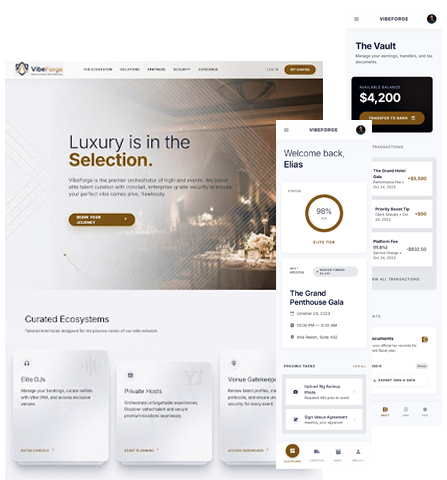
The Compact Site.
The corporate brochure is dead. Welcome to the era of extreme-speed, modal-driven digital architecture designed explicitly for maximum psychological retention.
The Cognitive Overload Trap.
For the last twenty years, local businesses have been sold a lie by marketing agencies: "You need a massive, 40-page website to look professional." So, businesses paid tens of thousands of dollars to build endless pages of corporate history, dense paragraphs, and complicated drop-down menus.
The problem? Human beings do not read websites; they scan them. When a homeowner has a leaking roof, they do not care about your mission statement from 1998. If they have to click through three different pages just to find your service area, their brain hits a cognitive threshold, and they abandon the site.
The Compact Site is our proprietary response to this bloat. It is an ultra-fast, highly concentrated digital storefront that delivers exactly what the user needs instantly, without ever forcing them to load a new page.
Hick's Law dictates that the time it takes for a person to make a decision increases logarithmically with the number and complexity of choices. A massive 40-page menu actively causes choice paralysis.

The Psychology of the Modal Interface
A Compact Site (like the one you are interacting with right now) doesn't use traditional page routing for core information. It uses high-speed modal windows. Here is the operational physics behind why this generates more revenue.
Zero-Latency Context
When a user clicks a link on a standard website, the screen goes white, the browser requests data from the server, and the user waits for a new page to draw. This breaks their cognitive flow. A modal interface preemptively loads the data into the browser's memory. When the user clicks "More Info," the data expands instantly over the current screen in under 100 milliseconds, satisfying their curiosity without ever causing a psychological interruption.
NNG: Response Time Limits (0.1s Benchmark)Attention Retention
If you send a user to a totally new webpage to read about your "Roofing Services," they often get distracted by other links on that new page and forget to fill out your contact form. Modals operate on a "Z-Index Lock." When the modal opens, the background dims, trapping the user's focus entirely on the information they requested. When they close the modal, they are instantly dropped right back onto your primary sales funnel where they left off.
Microsoft Research: Consumer AttentionPreserving The Flow State
In behavioral psychology, "Flow" is a state of frictionless momentum. Every time your website forces a user to navigate backward and forward through a maze of URLs, you introduce friction, increasing the likelihood of a bounce. By bringing the information to the user via overlapping panels, the Compact Site creates an unbroken, app-like flow state that drives them effortlessly toward the final conversion.
The Monopoly of Focus.
Every time a user clicks a link and waits for a new webpage to load, their brain undergoes a "context switch." They lose their immediate train of thought. We consider page-loading to be a catastrophic UX failure.
By deploying our data inside high-speed modals that overlay the current screen, we never force the user to abandon their context. They read the specifics, close the window, and are instantly back in the main conversion funnel. You maintain an absolute monopoly on their focus.
The Context Switching Penalty
American Psychological Association (APA) research proves that shifting between tasks or contexts—even for a few milliseconds—can cost up to 40% of someone's productive cognitive bandwidth. Modals eliminate this switch, preserving the user's conversion intent.
Working Memory Limits
Nielsen Norman Group confirms that users have severely limited working memory. Navigating away from a core landing page forces users to memorize where they were. Spatial overlays (modals) keep the primary page visible in the background, anchoring the user's spatial memory.
The Ultimate Paradox.
There is a famous paradox in modern web development. Humans want frictionless, app-like speed (modals, compact views, no page reloading). But Search Engines want deep, hierarchical, keyword-rich text documents (long-form pages and URL clusters).
If you build purely for humans, Google's bots won't have enough URLs to index. If you build purely for bots, your human traffic bounces.
The SEO Hybrid Moat
Our Compact Sites solve this riddle by utilizing a hybrid architecture. The primary homepage acts as the high-speed modal engine for the 80% of human users who just want to book you.
However, inside those modals, we weave invisible contextual links to standalone "Deep Dive" pages (like the exact page you are reading right now). This gives Google's crawling bots the vast, indexable URL structures they crave without ever cluttering the human user's experience.
Stop building brochures. Build a machine.
Get a beautiful, high-speed digital storefront built for 100% conversion and 100% SEO visibility. Setup begins at just $499 flat.